
Transport simulation on a vibration test stand
Test machine manufacturer: Vibration test and shock test
Securely packaging goods for shipment: Globally, goods and merchandise are shipped daily. During transit to the customer, packaging travels long distances. Both packaging and products are often subjected to significant stresses. These can include temperature fluctuations, mechanical shocks from road damage or package mishandling, as well as general vibrations during transport. All of this annually leads to numerous damage incidents, high costs, and dissatisfied customers.
Hänchen as general contractor in test stand construction
As a test machine manufacturer, we design individual functional test stands for material testing of packaging, catering to large-scale shippers and testing service providers. These test plants, designed for vibration tests and shock tests, offer an excellent foundation for transport simulation. The test stands accurately simulate the loads and conditions encountered during transport for both products and their packaging. The data acquired from these tests enables the development of more secure packaging designs, effectively preventing significant costs associated with transit damage.
- Individual function test stands
- Automatically evaluated test reports
- Safety concepts up to PLe
- Software adapted to customer requirements
- Modern test engineering
- Versatile applications


Requirement profile
Test plant for packaging
Functional test stands Ratio-Drive®
Functional test stands help to optimise packaging. Optimised packaging is better able to withstand vibration during road transport, impacts and shocks from throwing packages, and even climatic changes. Damage to the goods being shipped can thus be avoided.
- Vibration test
- Shock test
- Shaker test
- Drop test
- Compression test
Standards for transport simulation
There are various standards that describe the requirements that packaging must meet in order to withstand certain transport loads. We can help you with implementation.
- International Safe Transit Association (ISTA)
- American Society for Testing and Materials (ASTM)
- DIN EN ISO
- Amazon, UPS or DHL
Packaging test in the simulation
test stand - Shipping goods safely with optimised packaging
Large mail-order companies in particular know the problem only too well. Many packages suffer during transport and arrive damaged at the customer's premises. If the contents are then damaged, this is almost always at the expense of the sender. This is because they have to prove that the product arrives undamaged at the customer's premises. Many large mail-order companies and logistics companies rely on their own standards for product packaging. In the transport of goods, the specifications of the International Safe Transit Association (ISTA), the American Society for Testing and Materials (ASTM), the DIN EN ISO standards and other standardisation organisations are applied. Large companies such as Amazon, UPS or DHL often have their own standards. They specify the requirements that packaging must meet in order to withstand certain transport loads. On the basis of these specifications, Hänchen designs the required functional test stand individually.
The load test of the packaging is carried out using precisely calculated test methods that are simulated by means of a vibration test stand and shock tests. They are designed to realistically reproduce situations that arise during transport with a wide variety of means of transport and thus prevent transport damage. This includes vibrations caused by road transport, impacts and shocks caused by throwing packages or climatic changes, for example in winter when reloading from a warm warehouse into a cold transporter.
Testing, analysis and evaluation of the data obtained enables the design of product-specific packaging that prevents transport damage.
Turnkey test stands
The special machine construction Ratio-Drive® division from Hänchen offers simulation test stands according to the individual specifications of the customer. This can include vibration testing, shock testing, vibration and drop testing or compression testing. Consulting, engineering and implementation are all from a single source. Ratio-Drive® means: The customer knows the process that the machine has to map, Hänchen builds the special machine. The individually configured software developed by Hänchen enables precise control of all test stand processes. Components such as hydraulic cylinders from our production or electrical drive solutions from other manufacturers can be used. The customer receives a customized, turnkey functional test stand that consists of powerful modules.
Shaker and vibration test stand
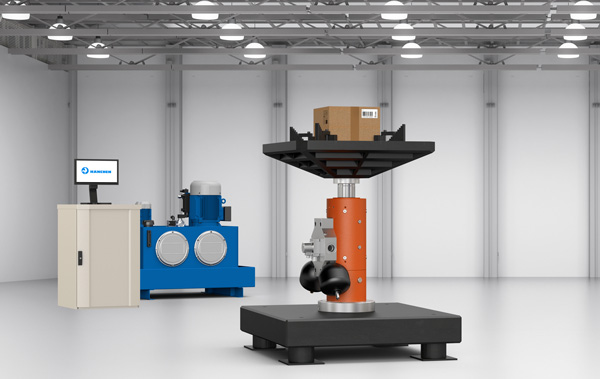
During vibration tests, the packed goods are exposed to vibration loads. They specifically simulate mechanical-dynamic loads, such as those that occur during automotive transport. In order to map the journey as a sinusoidal vibration test, all parameters with the spectral acceleration density g2Hz are entered into the Hänchen software for test stand control. The test actuator precisely performs this vibration test.
Hänchen's special machine construction division designs and builds shaking and vibration test stands for test specimens with a mass of up to 150 kg and package dimensions of up to 800 x 800 mm. Depending on customer specifications, the test frequency range is up to 200 Hz with a correspondingly possible amplitude of up to ± 30 mm. However, both values cannot be achieved physically at the same time, but must be defined to suit the testing task. The task is implemented using a hydraulic cylinder with hydrostatically mounted piston rod guide as an actuator, a hydraulic power unit and a mounting plate for the test specimen, as well as electronics hardware and software. An interface for automated data exchange between the vibration test stand and ERP system can also be implemented here. Fixing units, stacking devices, noise protection, safety enclosures, climatic chambers and salt spray tests are also available as options.
Shock test stand and drop test
Shock test stands are used to simulate errors during handling during the transport process and are used to check product stability. Hänchen offers a lifting device here that simulates the drop height and force. Impact movements with high acceleration can be achieved using hydraulic cylinders. The test stands are always designed in accordance with the applicable machinery directive and implement the required protective measures. It must be taken into account, for example, that a test object can fall uncontrollably due to incorrect operation or technical failures. For example, a package weighing 150 kg quickly reaches a very high force on impact when dropped. A falling test object could therefore cause serious injury to a person.
Compression test
Before the packages arrive at your recipient, they are stacked on top of each other in the warehouse before dispatch and during transport. The packaging must also withstand the load required by the shipping company in this scenario. Hänchen simulates these long-term and short-term loads using compression testing machines according to customer requirements.
Ultimately, all these tests serve to ensure the safety of the goods and to optimise packaging in order to avoid unnecessary waste. They are documented with automatically evaluated and verified test reports. The transport loads determined in this way can then be optimally taken into account by improving the packaging and by using appropriately adapted filling materials in the package. This is an important contribution to ensuring that the goods arrive at the end provider or customer in optimum condition.
Jörg Beyer, mediaword
© Hänchen 2021

EU Packaging Regulation 2025/40
Lean Packaging
EU Packaging Regulation 2025/40 (PPWR) requires, among other things,
- Max. 50% empty space in shipping/e-commerce packaging
- Higher recycled content (starting in 2030: 30–35% in plastic packaging)
- Performance certification for vibration, shock, and climate—no false advertising.
Your tests, our technology:
- Stresses during loading and unloading
Falling or bumping into other packages or hard surfaces.
- Bumps in the road
Cobblestones, potholes, or sorting facilities.
- Compressive stress in the transport medium
By stacking them in the delivery van or squeezing them in turns (from above, below, or the sides).
The benefits of choosing Hänchen:
- Audit Reports for PPWR Auditors
- Minimized shipping damage
- Optimal material reduction without risk
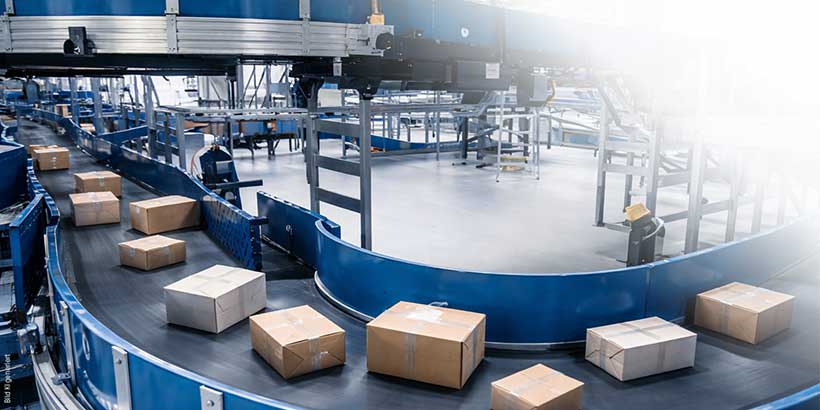
: Sorting Systems and Durable Packaging
In sorting facilities, packaging is subjected to significant mechanical stress. During the process, it is rubbed, crushed, and compressed.
This stress can cause packaging to become damaged or lose its functionality.
Typical “shock” effects on packaging in sorting facilities include, for example:
- Drop impacts
At the transfer point between conveyor belts, packages can fall from heights ranging from 20 cm to over 1 m.
Result:- Dents in cardboard boxes
- Breakage of fragile products
- Damage to corners/edges
- Compression shocks
In congestion zones, packages may collide, become wedged, or be temporarily stacked on top of one another. This is particularly critical when packages have different weights (heavy on top of light).
Result:- Bruises
- Structural failure of the packaging
- Removing adhesive bonds
- Vibration
Micro-shocks to packages caused by roller conveyors, motors, and conveyor belts—that is, many small impacts over a long period of time.
Result:- Material fatigue
- Pulverization of delicate goods

Customer Satisfaction
Undamaged Packaging
You know how it goes: The doorbell rings, you open the door—and before you can even react, the package lands with a loud thud in the entryway.
By the time it gets there, your products have usually been on quite an adventure:
- Vibrations during road transport
- Drop loads during transshipment
- pressure crushing caused by stacking in the warehouse and in transport carts
- Shocks caused by potholes or sudden braking
- A hard landing when parking
Each of these stresses affects the packaging—and plays a key role in determining whether your product arrives undamaged.
To help you, as the shipper, play it safe, Hänchen realistically simulates your shipping process—from the first jolt to the final impact.
Hänchen Ratio-Drive® - The complete solution for drive systems & test stand construction
- Extensive know-how in special machine construction of hydraulic and electrical special machines
- Experience in the systematised, individual design and realisation of customer projects
- Measurement, control and regulation technology, real-time control, measured value acquisition, sensor technology, fieldbus connection and evaluation
- Development of proprietary modular software, including graphical interface for control and regulation as well as communication at process level
- Planning and implementation of test machines
- Individual test stand construction
- Comprehensive safety concepts up to PLe in accordance with the Machinery Directive, CE conformity, safety software